Start with the architecture.
Synthesize the NTF, select a topology, and scale states to your integrator swing limits. Inspect the ABCD matrix and a, g, b, c coefficients.
Design and verify incremental sigma-delta ADCs in one traceable workflow. Move from NTF synthesis to capacitor ratios, nonideal behavior and statistical signoff.
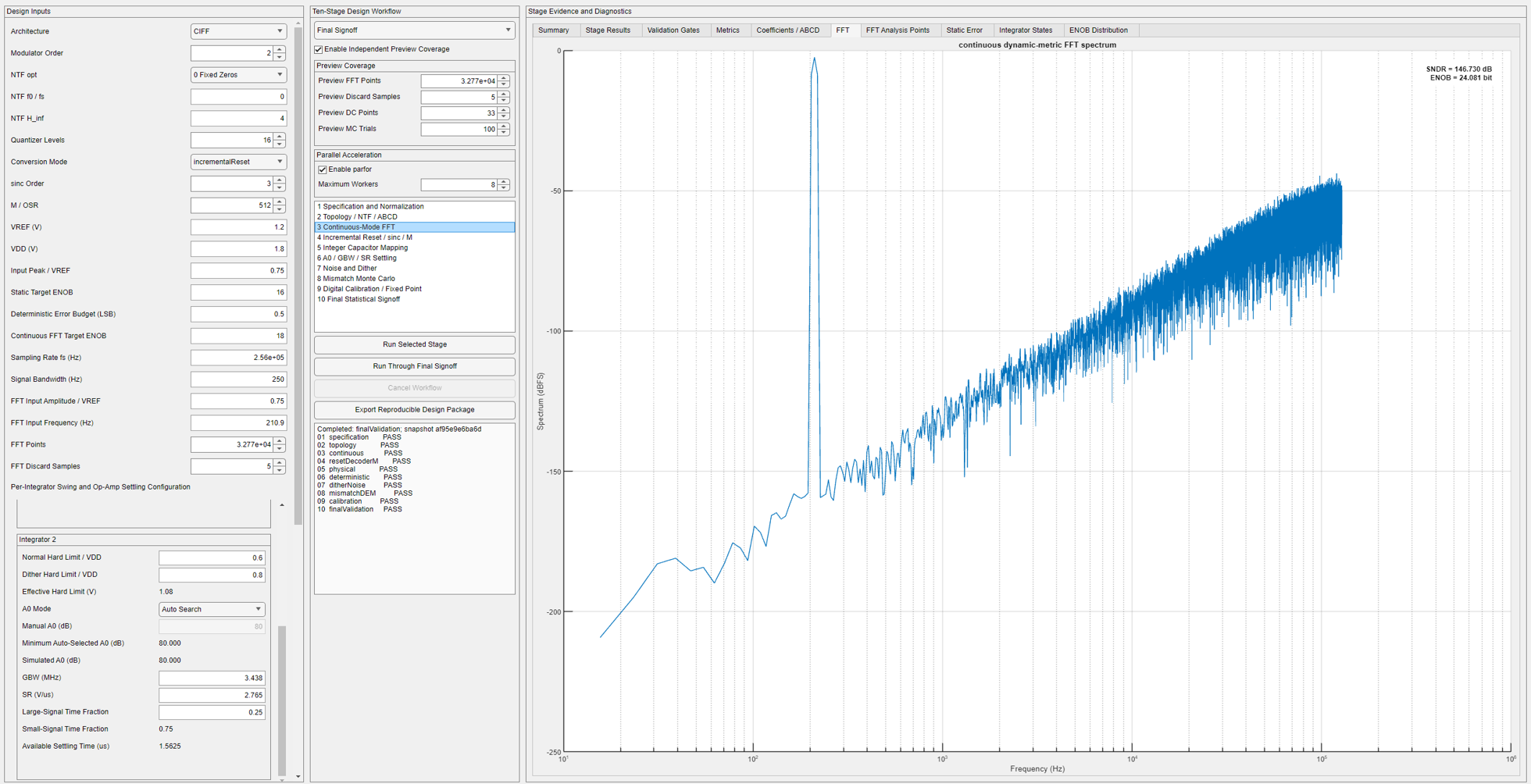
Screenshot: ideal continuous-mode FFT, before noise and mismatch. The displayed ENOB is a model result for these settings, not a guaranteed hardware specification.
01 / CAPABILITIES
See how implementation choices affect your design, with coefficients, waveforms and validation gates at every stage.
Synthesize the NTF, select a topology, and scale states to your integrator swing limits. Inspect the ABCD matrix and a, g, b, c coefficients.
Convert coefficients to common-denominator integer capacitor ratios. See unit counts, coefficient error, thermal-noise sizing and differential capacitance.
Configure each integrator’s gain, bandwidth, slew rate and output swing. Use manual gain or automatic search and inspect the resulting evidence.
Explore input-referred sampling thermal noise, dither and capacitor mismatch. Compare static error, dynamic FFT and Monte Carlo yield.
Evaluate incremental reset and finite-window sinc decoding. Scan M candidates against your deterministic-error budget.
Follow per-stage validation gates, apply two-point calibration, save projects and export a reproducible design package after final acceptance.
02 / WORKFLOW
Run a selected stage while exploring. Run through final signoff when you are ready to evaluate the complete design.
Ranges, targets and budgets
NTF, ABCD and state scaling
SNDR and dynamic ENOB
Reset, sinc decoder and M
Integer ratios and capacitance
Finite gain and settling
FFT and statistical DC sweep
Static, dynamic and combined yield
Per-device gain and offset
Combined budget and coverage
A completed simulation and a passing design are distinct. Validation gates show the actual value, limit and reason when a design fails.
03 / DESIGN EVIDENCE
Inspect the synthesized coefficients in the App, then use the design parameters to build and verify your own switched-capacitor implementation.
NTF, ABCD and coefficients stay visible throughout the workflow.
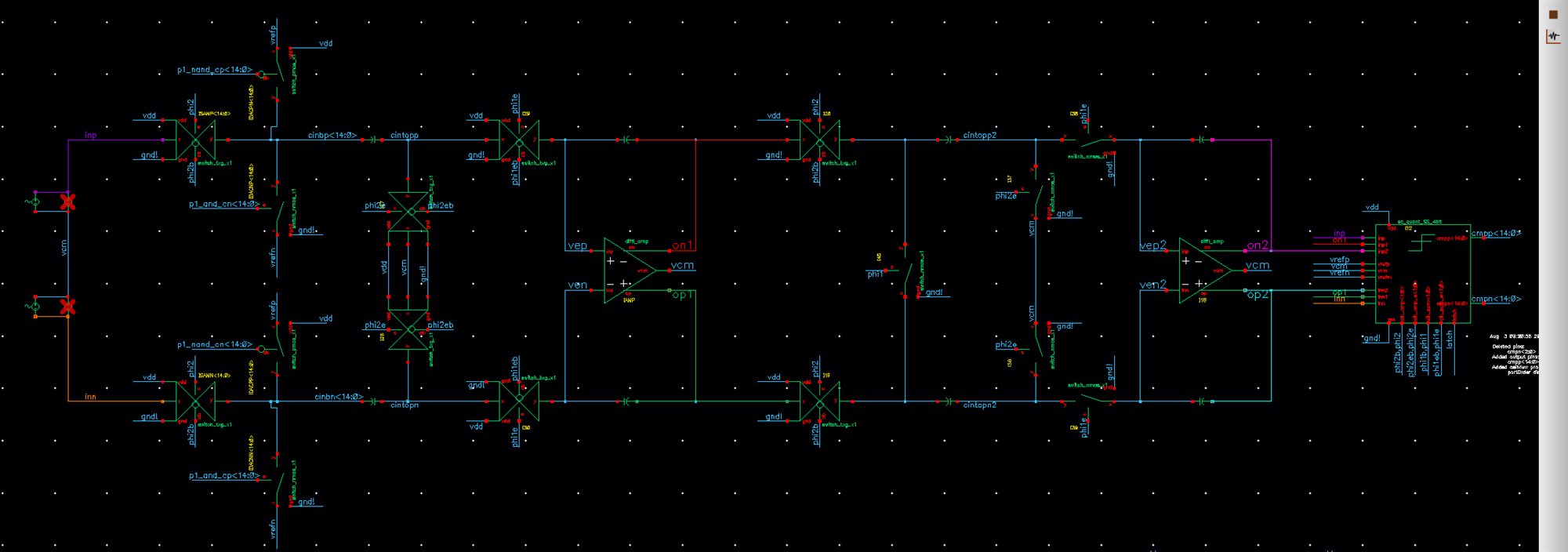
A second-order CIFF circuit-model example created from App parameters.
04 / GET THE APP
A downloadable MATLAB App for engineers and researchers working on incremental sigma-delta ADCs.
Requires MATLAB R2022b or newer and a separately installed, compatible Delta-Sigma Toolbox. Parallel acceleration requires Parallel Computing Toolbox.
Read installation requirementsOnline checkout is not open yet. No payment can be taken on this page.
Read the license terms05 / QUESTIONS
CONTACT